
Unity and Difference
Essay · John Borneman on Why Syria, Lebanon, and Diaspora Communities Reveal That Political Order Is Never About Producing Unity, but About Living With Difference

What Holds a Heterogeneous Society Together?
Anthropologist John Borneman argues that unity is never the absence of difference but the fragile capacity to live with it. Drawing on ethnographic fieldwork in Lebanon since 1999 and among Syrians in exile in Istanbul and Berlin, he shows that most societies begin already heterogeneous, that imperial and mandate orders institutionalised rather than created communal difference, and that diaspora life can sometimes generate new forms of coexistence that were nearly impossible at home. The question of political order, he suggests, is therefore never how to produce unity but how to sustain it under pressures to splinter.
Essential points in this essay:
Most societies begin already heterogeneous; the problem of political order is never how to produce unity but how to accept and manage difference
The Ottoman, mandate, and Assad systems did not create sectarian difference but institutionalised it — and when those systems collapsed, new forms of coexistence and incorporation emerged
What changes after rupture is not the differences themselves but the boundary that organises them; under new conditions, internal threats can become merely one difference among others
About the author: John Borneman is Emeritus Professor of Anthropology at Princeton University. His most recent book is I Was Married to a Horse, and Other Tales of an Accidental Anthropologist (2026, HAU Books, distributed by University of Chicago Press).
We often imagine unity as the absence of difference. Yet the unity of the self is not the elimination of difference but the tenuous capacity to live with it. If difference already lives within us, the real question becomes how the self holds together the conflicting identifications, desires, habits, and experiences that compose it. What the self shares with every scale of social organization — from families to nations — is this fragile capacity to live with the differences within. Sometimes that capacity proves inadequate, and people refuse to tolerate certain differences at all. The more intimate those differences appear to the self, the harder they are to ignore or bridge.
It is not that societies begin as homogeneous and later fragment into factions. Most societies begin already heterogeneous and engaged in forms of exchange with outside groups. The problem of political order is therefore never simply how to produce unity but how to accept and manage difference.
Mosaic Societies: Syria and Lebanon
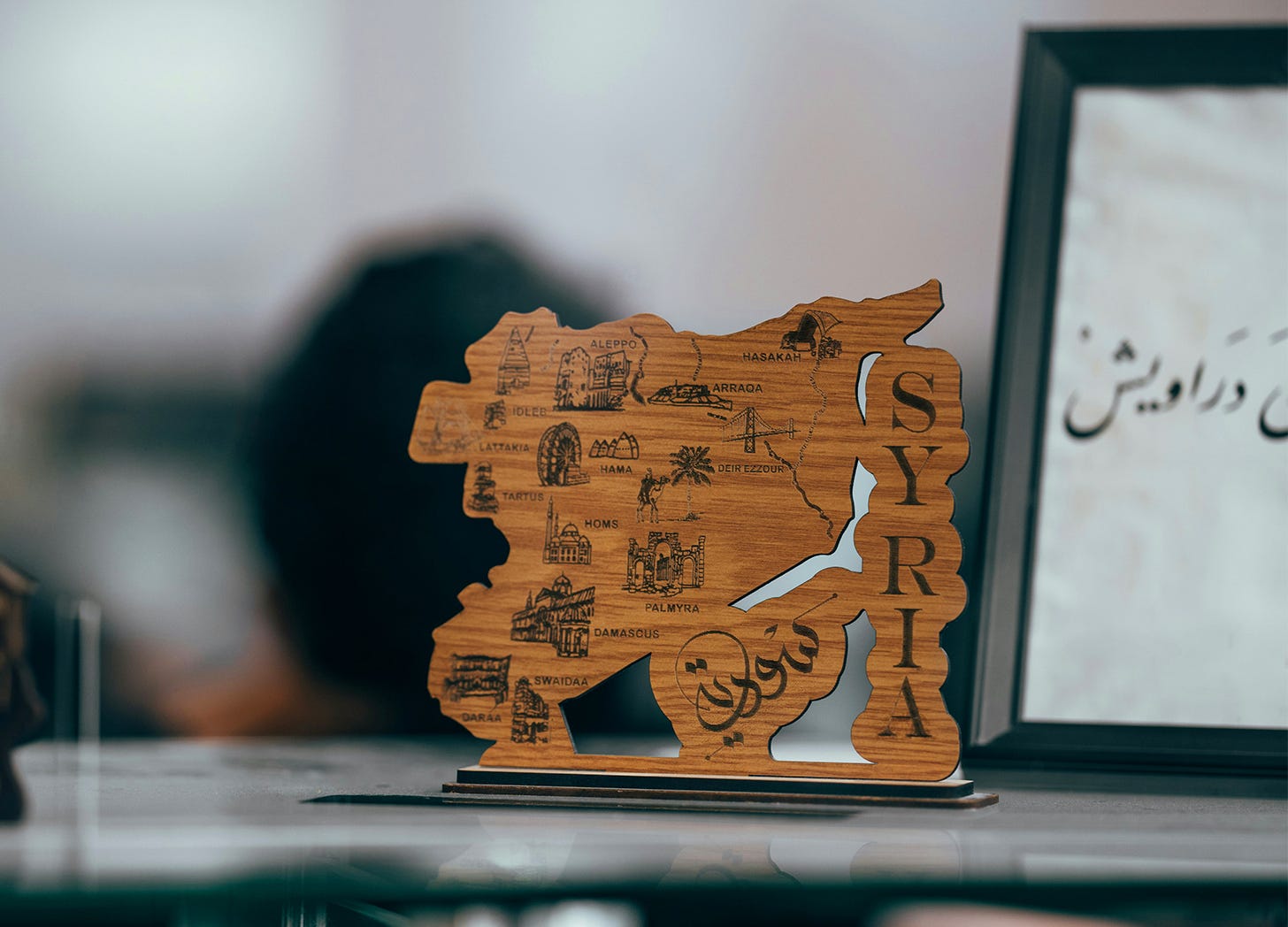
The history of Syria and Lebanon illustrates this point. Both territories once belonged to the Ottoman Empire, were reorganized under European mandate rule after the First World War, became separate administrative units in 1920, and obtained full independence only in 1946. The mandate system did not create difference but institutionalized it: communities that had long lived together were sorted into administrative categories that gradually hardened into political ones. One state became a dictatorship, the other a democracy.
Both societies are often described as mosaics: Sunni, Alawite, Druze, Shi’a, Maronite, Orthodox, Armenian, and many others. Marriage remains overwhelmingly endogamous, with a strong preference for cousin marriage that keeps solidarities tight and boundaries carefully maintained. Even when people move to cities or abroad, kin networks continue to organize economic life, marriage alliances, and political loyalties. The nation is imagined as a whole, but everyday life is structured through smaller solidarities that precede it. Most of the time this layering produces accommodation rather than conflict. But when political power becomes unevenly distributed or economic crises intensify competition, these same differences can be mobilized as threats.
“The mandate system did not create difference but institutionalized it: communities that had long lived together were sorted into administrative categories that gradually hardened into political ones.”
When I began research in Lebanon in 1999, I was interested in the texture of social life after a fifteen-year civil war that had ended only with the interventions of Syria and Israel. I already had contact with a Sunni man, quickly became friends with a Maronite Christian — Christians themselves comprise at least thirteen denominations — and befriended a Shi’a and a Muslim Kurd. For an ethnographer, depth is more important than breadth, which meant I only fleetingly met members of other groups. I had many one-on-one conversations but also accompanied my new acquaintances — often with their friends — to beaches, cafés, restaurants, and universities, and was frequently invited into their homes. What I observed was not unity but its fragile precondition: people incorporating difference into their social lives through proximity and routine.
When the State Collapses: The Reckoning After Defeat
The Syrian uprising of 2011 morphed into a brutal war of the state against its citizens and then into a civil war between competing factions supported by different external powers. The United States and Saudi Arabia aligned to eliminate the regime, while Russia and Hezbollah intervened to sustain it. Eventually the external coalition opposing the regime withdrew, and by December 2024 the state — exhausted and hollowed out by years of war — collapsed when an internal faction of Sunni rebels captured the capital within weeks.
Defeat, when it is total, can force a reckoning that victory rarely permits. Germany after 1945 is the clearest modern example. The completeness of the collapse left little room for self-exculpatory myth: no “stab-in-the-back” narrative could survive unconditional surrender, occupation, and the exposure of the camps. What followed, slowly and unevenly, was something rare in political life: an institutionalized modesty. For several generations German public culture made the acknowledgment of loss and atrocity a civic obligation, produced through education, law, memorialization, and sustained international pressure.
Syria’s destruction might produce a comparable reckoning, though the context presents more radical obstacles to the organization of order. The new government emerged not from foreign occupation but from an indigenous rebellion that ultimately prevailed. Revolutions often appear as sudden reversals, yet they unfold as longer processes of social transformation marked by reversals and unanticipated outcomes.
Diaspora as a Laboratory of Coexistence
The early signs from Syrians in diaspora — the very people whose departure most unsettled the regime — remain ambiguous. Israel now seems intent on destabilizing the regime from the outside. Yet before the regime fell, I visited Syrian exiles in Istanbul and later lived among them in Berlin. People who had rarely shared space inside Syria were now living side by side. What struck me was not merely coexistence but something more active: Alawites, Druze, Christians, and Sunnis collaborating in improvised exile organizations; their children attending the same schools; disputes mediated through new informal institutions — local religious leaders, neighborhood networks, and municipal authorities rather than the old sectarian structures. A younger generation organized across lines that had been nearly impossible to cross inside Syria. The structures of the Assad state — which had managed difference through patronage, surveillance, and controlled rivalry — were simply absent, and in their absence new affiliations emerged.
Before the regime’s collapse, over half of the Syrian population had been internally displaced and perhaps thirty percent had gone into exile. Rebuilding a destroyed country now requires people carrying old loyalties and animosities within themselves to work alongside those who once persecuted them. What I witnessed in diaspora may foreshadow a future Syria in which the boundary between inside and outside shifts, and those returning and those who remained bring new forms of coexistence into being.
The Shifting Boundary: What Changes Is Not Difference Itself
The differences themselves will not disappear. They remain present in memory, in language, in habits of comportment, and in the small gestures of recognition and avoidance that structure everyday life among people who share a history. What changes is the context in which those differences are lived. When Syrians and Lebanese encountered one another in Berlin, Istanbul, or the United States, they met first as migrants — often simply as Arabic speakers navigating the same bureaucratic obstacles: residence permits, employment, schooling for their children. The categories that once structured everyday life — sect, village, political faction — did not vanish, but they were displaced by other lines of belonging.
What changed was not the differences themselves but the boundary that organized them. As Diana Fuss has argued, identity depends on an unstable relation between inside and outside — the inside requiring the outside even as it fears contamination from it. Yet, when the surrounding context changes, what had once been experienced as an internal threat can become merely one difference among others — still present, still felt, but no longer organized as a line of conflict.
“What changed was not the differences themselves but the boundary that organized them. When the surrounding context changes, what had once been experienced as an internal threat can become merely one difference among others.”
The question the Syrian and Lebanese cases keep posing is therefore not how unity is achieved but how it is sustained under pressures to splinter. Most of the time the answer lies not in shared identity but in the gradual, uneven, never guaranteed development of a capacity to live with the differences within.
John Borneman is Emeritus Professor of Anthropology at Princeton University. His most recent book is I Was Married to a Horse, and Other Tales of an Accidental Anthropologist (2026, HAU Books, distributed by University of Chicago Press). His ethnographic research has spanned Berlin, Lebanon, Syria, and the United States, with sustained attention to kinship, political authority, accountability after violence, and the inner lives of social actors.
Futures of Difference is produced by Steven Vertovec at the Max Planck Institute for Political and Social Science (formerly the Max Planck Institute for the Study of Religious and Ethnic Diversity).