
Social Categories and Decolonial Thinking
Short · Ann Phoenix on co-hoping, shifting alliances, and why the category "human" is exclusionary

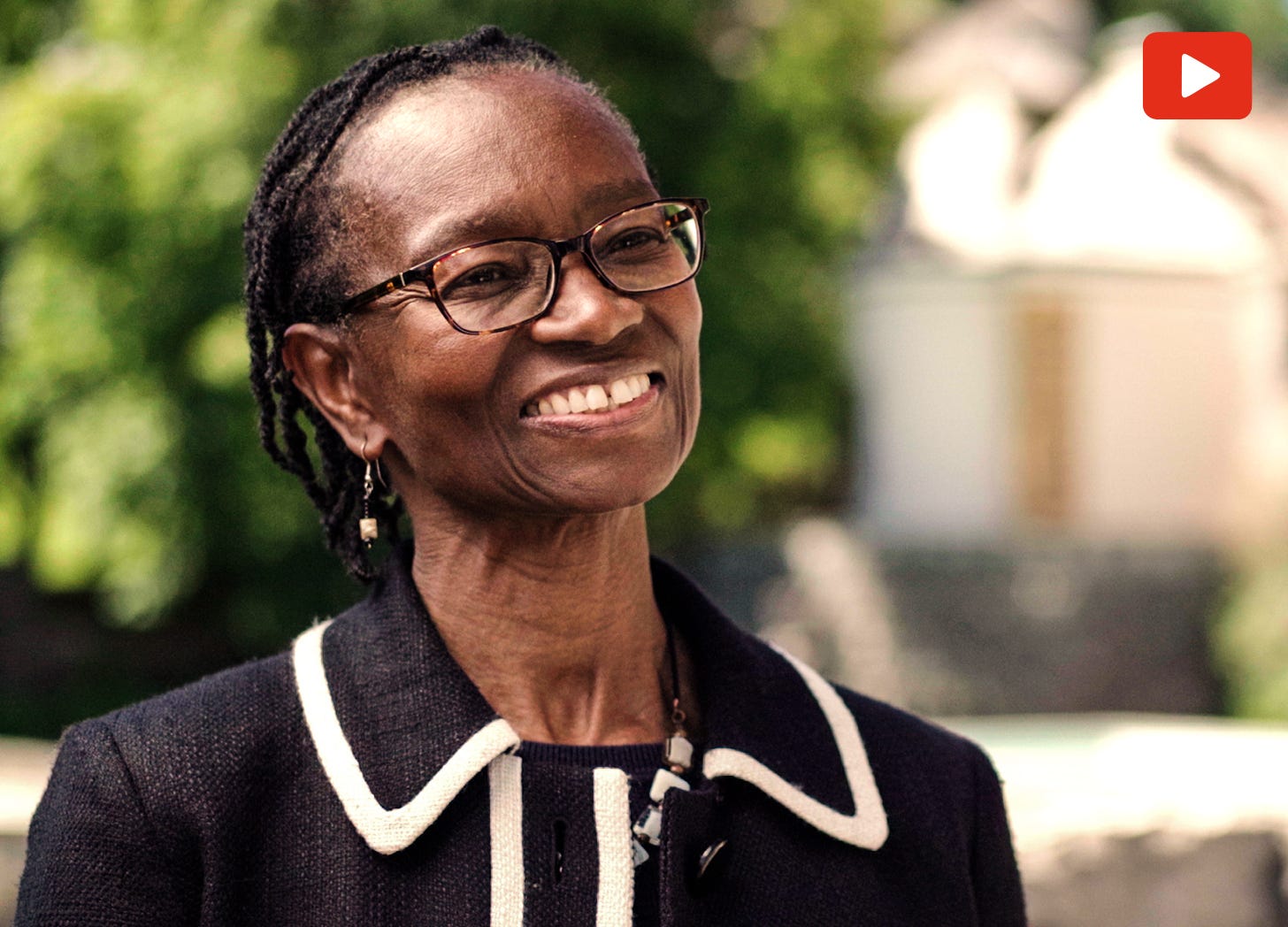
Hope is not equally distributed — and that matters for how we imagine the future of diversity.
In this workshop reflection from Schloss Ringberg, psychologist Ann Phoenix weaves together the key threads of the Futures of Difference gathering: the demographic realities that will make African youth indispensable to the world, the need to decenter Western epistemologies, and the concept of “co-hoping” — hoping with people rather than against them. Her central provocation: the very category “human” has functioned as exclusionary, and genuine equality requires starting from a fundamentally different place.
We asked:
“Looking back at this workshop, what are the key insights you take away?”
Phoenix’s reflection serves as an integrative summary of the Futures of Difference workshop, connecting the contributions of Dan Hiebert on demography, Brenda Yeoh on decolonial perspectives, Miri Song on categorical thinking, and Michèle Lamont on moral narratives. Her full conversation in Episode 5 of the podcast explores intersectionality, essentialism, and the psychosocial approach to identity in greater depth.
About: Prof. Ann Phoenix is a professor of Psychosocial Studies at the UCL Institute of Education and Fellow of the British Academy, whose research addresses motherhood, social identities, racialisation, and gender.
Full statement
Looking back at this workshop, what are the key insights you take away?
So one of the things that’s really struck me about this whole conference with the people who are here is that everybody is absolutely brilliant at narratives. Partly academics have to be able to tell stories about their research and so on. But in terms of people being able to craft the narrative at short notice, that’s been very important. And it’s been important that everybody has had a narrative that aims in the same direction.
So everybody assumes that their narratives are about a more hopeful migratory future. So understanding diversity in the future as something that’s understood as good, as usual, and so on, rather than something that’s taken to be problematic. And I think that one of the issues that arises then is, are we talking about the same thing? So if we take an overview of what everybody’s saying, are we talking about the same thing?
And we all agree with what people have said and it’s been really interesting and important. But we’ve not actually staged each other’s talks against each other. And what I mean by that is if you think about starting off on the very first day, so not the first evening, but the first day with Steve’s talk and then following it with the four impulse talks.
I found those absolutely fascinating. So we started off with thinking about demography from Dan. And that was fascinating because he told a story in a way that we don’t often hear, that would end up with, if we’re thinking about the future of the world, that the only growth area of population will be on the African continent, which will mean that’s where young people are on.
Indeed, the African continent already has more young people than other places. So that will mean that for all the things that need to be done in the world, thinking about healthcare, thinking about providing food, and so on, that it will be people from the African continent who will have to be solicited in other countries. So that means that we need to think about how will people in countries of the global minority, the affluent global minority, think about Africans when there is such an anti-migration discourse.
Things will have to change. Will that mean a hopeful narrative in the future? And remember that narratives are always stories told in the present, building on what’s happened in the past in anticipation of a particular future and for particular audiences. So for this audience, we then had impulse talks that included Brenda Yeoh talking about the fact that so much of our discourse, the narratives that we’re telling now, in this context, even though we are saying we want something different, so much of our discourses are actually from the position and perspective of the minority world and therefore we really need to think about, as she called it, post-coloniality, I would say, a decolonial perspective where we think about what would it mean, for example, if we stage Brenda Yeoh’s and Dan’s talks together, what would it mean to look from the African continent at being the young people who the world wants, but also recognizing racism and so on.
What would it mean to take an African lens? And, you know, from specific countries as well, not just the whole continent. And would it be that the same concerns around trying to get over the racism would be key or to shift inclusion in the category human, which is so often left out for people from the African continent? So we would have a rather different view.
So too, if we brought together Miri Song’s talk with Dan’s, we would get something slightly different in that what Miri Song had to say is that it’s very unsatisfactory at the moment trying to think about demography, because the categories that we are using are problematic. The categories that we’re using don’t actually reflect mixedness a great deal.
So what do we need to do to arrive at a better future? We need to think about categories. Which brings us back again to Steve’s talk where he’s concerned about categories, representations, and he’s concerned to bring that into play with encounters. The way we think about categorie, the African youth needed in European countries, for example, the way we think about mixedness, racialization in general, has an impact on both how we relate to people and how those relationships affect our categorical thinking, but all of it within a backdrop that is structural.
So, you know, he is very much thinking about the configuration or as the structural backdrop where that needs to shift as much as our representations and encounters do. So all of these things brought into play, call up what is a moral issue as well, where we need to be thinking about how do we make changes, you know, that actually matter. And, if we think about Michèle’’s intervention, hers was also about, you know, taking a moral stance, social statistics, social demography, actually needing to be in a context where we’re thinking about narratives, we’re thinking about the moral and so on.
One of the important things about what Michèle Lamont had to say was that we need to be thinking very much demographically, yes indeed, so that social demography matters, but we have to contextualize that and we have to contextualize it in terms of morality so that we have to know which end points we’re aiming at, which means that narratives matter, but actually they matter only if we take what might be seen as a values perspective, so that we know what we’re aiming for and that we don’t actually make changes that are amoral or that are non-directional and so on.
So if we think about, you know, Steve’s talk and then the five impulse talks that followed, including the one that I gave, on what I very strongly believe is crucially important, the importance of intersectionality and hauntology, the way in which the past is differentiated and it is very much part of the present, so very much fitting with narrative theory, and it affects the future and the futures shift and change all the time as the present changes and as we understand the past differently.
So none of these things are set and it depends on the categories to which we belong, So that our positionality matters and makes a difference. If we think about those five talks right at the beginning, these are themes that have gone through the day and a half that’s followed in that everybody has been concerned to think, well, you know, how do we shift categories?
Should we be thinking about shifting the content of the categories? Or should we be thinking about the power relations that mean that some categories are hierarchically above others? And how do we do that? How can we aim towards the future? What are the paths? What are the contradictions? How is it that people who we would not think of as being progressive are able to get their ways of looking at the world over, while people who we would think of as progressive don’t manage to do so?
What do we need to do? And do we need to have better stories that will be emotionally resonant with people and will fit with things that affect their lives? ? So we take seriously the fact that, for example, the white working classes feel dumbed down in Britain, in the United States, in Germany and so on. How can we do that? So again, categories, relations, thinking at the macro, micro and meso levels, all of those things are important.
And yet there are definitely hopeful signs. Now I very much love Ghassan Hage’s notion of co-hoping. And what he says is that hope is unevenly distributed. When we’re talking about hope, not everybody can hope in the same way because of the ways in which they are positioned in categories that don’t have much power and so on. So that we need to think about hoping with people, not against people.
I shouldn’t be hoping for something that would mean that you would have to be done down. And I think that that’s really important and it’s something that even if not in those terms came up again and again. How do we collaborate with people? And in the last bit of discussions that we were having just now, both in visiting other groups and in thinking about our own group, and we I was in the narrative group, one of the things that is absolutely crucial and that came up again and again is that we need to think about how we collaborate.
And my view, and one we discussed a bit, is that in terms of collaborations, we don’t need coalitions. We don’t need to think about long lasting collaborations. We need to think intersectionality. And we need to therefore think about shifting alliances and the ways in which shifting alliances mean that we can ally with different people at different times without offending or upsetting anyone, because we know that we’re allying for something positive at a particular moment.
One thing that I think that is very important, and is worth saying again and again, is that we need to think about our epistemologies. And when academics really are exposed around the world to very similar sorts of thinking. It’s very easy to take a perspective that epistemologically starts from a position that assumes a privilege in the world. Whereas what many decolonial scholars are arguing is that you need to think differently, that actually if you think differently, you recognise something that’s really very important.
One is that the very category human is exclusionary. And that doesn’t mean to say that, for example, black people and Asian people aren’t understood to be human, but actually in terms of whole humanity, in terms of feeling that they are genuinely thinking, people with enough cognition and emotion and that they have histories that are worthwhile rather than being, you know, somehow ahistorical or not much worth.
But we need to start somewhere else if we’re going to have genuine equality. And I think that’s something that actually people had to be, not had to be reminded of, but it was worth saying in the group. And I think that another issue is very much about the fact that even though we’re going to the same point, we all agree on the same things. We have very different disciplinary approaches and we have different ways of understanding what the issues are.
And sometimes we all fall into the same traps of using the same languages. And I think that one of the reasons that narratives is so important is actually not using the language, the discourses of, for example, the far right in order to make our points but recognizing that one has to disrupt that thinking.
Futures of Difference is produced by Steven Vertovec at the Max Planck Institute for Political and Social Science (formerly the Max Planck Institute for the Study of Religious and Ethnic Diversity).