
Muslim Discrimination or Islamophobia? Concepts for Advancing Efforts Against Exclusion
Essay · Marcel Maussen on Why Both Concepts Are Needed — and What They Each Reveal About Hostility, Inequality, and the Power Structures Behind Anti-Muslim Phenomena

Should We Speak of Islamophobia or Muslim Discrimination?
Political scientist Marcel Maussen argues we need both. Islamophobia, anti-Muslim hatred, and anti-Muslim racism capture the historical, cultural, and discursive structures — colonial legacies, Orientalist tropes, “Great Replacement” conspiracies — that make hostility towards Muslims durable and recognisable. Muslim discrimination, by contrast, plugs anti-Muslim phenomena into the established machinery of human rights law and anti-discrimination policy: legal definitions, remedies for victims, and positive duties on employers and public bodies. Used together, the concepts let us address concrete unequal treatment without losing sight of the deeper structures that produce it.
Essential points in this essay:
Islamophobia, anti-Muslim hatred, and anti-Muslim racism foreground discourse, representation, and historical power — they explain why hostility takes the forms it does and how it links to Orientalism, colonialism, and contemporary far-right narratives
Muslim discrimination connects anti-Muslim phenomena to legal and policy frameworks (the 1965 ICERD, EU anti-discrimination law, Public Sector Equality Duty) and addresses indirect and structural inequality without presupposing one psychological cause
Used exclusively, Muslim discrimination risks flattening intersectionality and obscuring structural forces; the productive move is complementary use — Islamophobia for cultural and historical diagnosis, Muslim discrimination for legal and policy intervention
About the author: Marcel Maussen is Associate Professor in the Department of Political Science at the University of Amsterdam. His research focuses on the governance of religious and cultural diversity, Islam in Europe, democratic theory, racism, and discrimination.
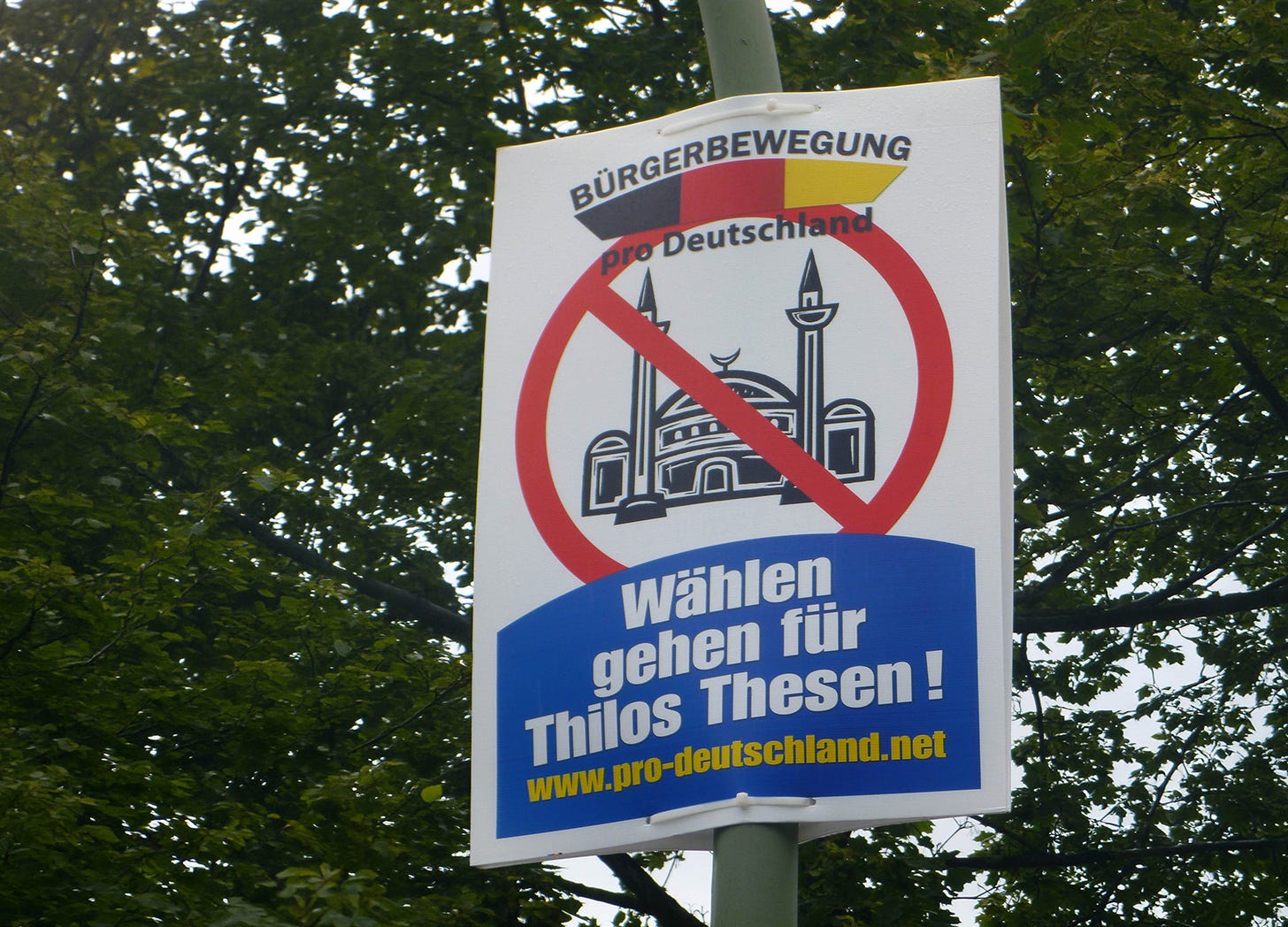
In countries where Islam is a minority religion and predominantly practiced by people of migrant origin — such as in Western Europe, North America, and Oceania — Muslims are frequently confronted with hostility, exclusion, and stereotyping. Over the past three decades, two main clusters of concepts have emerged to name and interpret these phenomena.
The first cluster centers on Islamophobia, including terms such as anti-Muslim hatred and anti-Muslim racism. The second cluster foregrounds Muslim discrimination, framing anti-Muslim phenomena primarily in relation to inequality and unequal treatment.
This essay discusses the strengths and limitations of these concepts. It argues that, while Islamophobia remains crucial for understanding cultural, political, and historical dynamics, the term Muslim discrimination holds particular promise when we aim to concretely address unequal treatment and disadvantage. At the same time, an exclusive focus on Muslim discrimination risks obscuring intersectional dynamics and deeper structural forces.
Islamophobia, Anti-Muslim Hatred, and Anti-Muslim Racism
The concept of Islamophobia entered public and academic debate in a prominent way with the 1997 report of the British Runnymede Trust, which defined it as “unfounded hostility towards Islam.” This notion situates hostility not in isolated individual prejudices, but in long-standing discourses and representations that depict Islam as inferior, irrational, or threatening.
These representations have deep roots in Western thought and practice. Islam has long functioned as a significant “other” in liberal philosophy, in Orientalist scholarship and literature, and in colonial governance. In British India, the Dutch East Indies, French North and West Africa, and elsewhere, rule over Muslim populations was tied to fears of unrest and to depreciative images of Islam. Distinctions between “good” and “bad” Islam, “moderate” and “fanatic” Muslims, or “civilized” and “backward” believers were intertwined with strategies of conquest and control.
Islamophobia as a concept highlights these power relations and historical structures. It underscores how contemporary hostility draws on older tropes that were reworked in the postcolonial and post–Second World War period, merging with debates on immigration, cultural diversity and secularism, and with security and counterterrorism discourses, which themselves were connected to developments and geo-political conflicts in the Middle East, Africa, South-East Asia, Turkey, the former Soviet Union, India, and Pakistan.
Islamophobia is thus a comprehensive term for capturing anti-Islam and anti-Muslim phenomena at the level of culture, politics, and historical power. It also draws attention to how stereotypical images and hate narratives are actively produced and circulated. Extreme right groups link Muslim presence in the West to conspiracy theories about “Eurabia” or the “Great Replacement,” using AI technologies and social media ecosystems to amplify these messages.
The term also helps connect these narratives to prejudices, beliefs, and attitudes. Islamophobia articulates how fear or criticism of the religion Islam is intertwined with hostility towards its believers. The related term anti-Muslim hatred emphasizes how such beliefs are internalized by individuals and institutions (politicians, police officers, teachers, employers) and how they inform everyday practices and decisions.
The notion of anti-Muslim racism overlaps with Islamophobia but adds the key dimension of racism: ideas that legitimize the subordination of groups defined by appearance, origin, ethnicity, or religion. It alerts us to racialization — the process by which Muslims, or those perceived as Muslim, are treated as if they constitute a quasi-racial group with fixed characteristics. Here, Muslimness becomes a stigmatized identity marker, intersecting with names, clothing, language, or national origin, and giving rise to a range of disadvantages.
From Islamophobia to Muslim Discrimination
A second cluster of concepts revolves around Muslim discrimination. The emphasis here shifts from discourses and images to how these background conditions translate into unequal life chances for people who are, or are perceived to be, Muslim.
The acts in question range from verbal hostility, threats, and attacks on persons or property to more subtle and institutional forms of unequal treatment. It highlights how adhering to Islam (or being perceived as such) becomes the basis for ascriptive discrimination.
Three major advantages follow from centering this concept.
Connection to legal frameworks. Muslim discrimination links directly to established national and international instruments, such as the International Convention on the Elimination of All Forms of Racial Discrimination (1965). In many jurisdictions (for instance within the EU), discrimination is a well-defined legal concept, embedded in human rights law and anti-discrimination legislation. This provides concrete tools: sanctions, remedies for victims, and positive duties on public authorities and employers to prevent discrimination.
Coverage of indirect and structural discrimination. Contemporary discrimination law and policy go beyond explicit hate speech or overt exclusion. They address indirect discrimination, where formally neutral rules have disproportionate negative effects on particular groups, regardless of intent. There is also growing attention to institutional, systemic, and structural discrimination, captured in duties such as the Public Sector Equality Duty, which requires public bodies not only to avoid discrimination but to proactively promote equality.
Avoiding psychological reductionism. The term Islamophobia carries the connotation of a single, deep cause: an “irrational fear” (a phobia) of Islam. This risks reducing a complex set of historical, political, and social processes to an individual psychological problem, and can suggest that the hostility targets the religion rather than believers. The danger is twofold: it may be misread as delegitimizing any critique of aspects of Islam, and it may encourage naïve responses, as if hostility towards Muslims would disappear simply through better information about Islam.
“The language of Muslim discrimination focuses on unequal treatment and outcomes, without presupposing one underlying psychological cause.”
By contrast, the language of Muslim discrimination focuses on unequal treatment and outcomes, without presupposing one underlying psychological cause.
Critiques and Risks of Centering Muslim Discrimination
Despite these advantages, there are important cautions against using Muslim discrimination as the primary or exclusive concept.
First, a focus on Muslim discrimination may obscure intersectionality — the ways discrimination based on religion interacts with gender, age, class, ethnicity, or migration status. It can give the impression that Muslims are discriminated against only as Muslims, or that all Muslims experience similar harms. In reality, the experiences of young Muslim men differ from those of older Muslim women, and both are shaped by how they are racialized, sexualized, and classed.
Because racialization blurs the boundaries between religious, ethnic, and racial categories, Muslims may also face forms of discrimination that target “immigrants,” “youth from the neighborhood,” or “foreign-looking” people. Policies that focus only on Muslim discrimination risk missing these broader dynamics and may reinforce fragmented approaches rather than addressing shared structural problems.
Second, Muslim discrimination can be interpreted too narrowly as intentional differential treatment — biased hiring, exclusionary speech, explicit denial of services. This risks shifting attention away from the historical and structural forces highlighted by Islamophobia: colonial legacies, global political hierarchies, and entrenched power relations. Addressing individual discriminatory acts is necessary but insufficient if deeper structures remain intact.
Towards a Complementary Use of Concepts
Rather than choosing definitively between Islamophobia and Muslim discrimination, it is more productive to see them as complementary.
Islamophobia, alongside notions such as anti-Muslim hatred and anti-Muslim racism, illuminates historical and cultural patterns of representation, the role of power and colonial legacies, and the symbolic construction of Muslims as a stigmatized “other.” Muslim discrimination directs attention to specific forms of unequal treatment and disadvantage, and connects these to legal and policy instruments for redress and prevention.
Given its growing prominence, there is a need to further clarify what Muslim discrimination encompasses. As a working definition, we might understand it as: all forms of unequal treatment and hostility that result in people who are Muslim — or whom others perceive as Muslim — being disadvantaged in their ability to practice their religion, be recognized for who they are, and participate on equal terms in social, economic, and political life.
Muslim discrimination can occur at the level of individuals, organizations, and institutions. Both governments and wider society bear responsibilities for addressing it.
To support empirical and legal clarity, it is useful to distinguish at least three basic forms.
Restrictions on religious freedom. Measures that apply specifically or disproportionately to Muslims or Islamic practices, and that treat them unequally compared to other religions or life-views — for example, regulations on religious dress, places of worship, burial, or religious education that are enforced more strictly for Muslims.
Disadvantage based on (perceived) religious identity. Unequal treatment in employment, housing, education, or access to public and private services, where the primary issue is not direct limitation of religious practice (though that may be a consequence) but disadvantage linked to being seen as Muslim.
Expressions and acts of hostility. Hate speech, harassment, threats, or physical attacks directed at persons, symbols, religious texts, or property associated with Muslims.
“Maintaining a conceptual dialogue between Islamophobia and Muslim discrimination allows us to relate concrete manifestations of inequality to the broader historical and structural forces that shape them.”
Analytically distinguishing these forms helps us identify specific mechanisms of exclusion and design more targeted interventions. At the same time, maintaining a conceptual dialogue between Islamophobia and Muslim discrimination allows us to relate concrete manifestations of inequality to the broader historical and structural forces that shape them — and to the political action of right-wing extremist actors actively promoting hostility and prejudice.
Marcel Maussen is Associate Professor in the Department of Political Science at the University of Amsterdam, where he is a member of the Challenges to Democratic Representation programme group. Trained as a political scientist and political theorist, he obtained his PhD in 2009 with a dissertation entitled Constructing Mosques: The Governance of Islam in France and the Netherlands. His work focuses on the governance of religious and cultural diversity, Islam in Europe, democratic theory, free speech, racism, and discrimination. He is the co-editor of Regulation of Speech in Multicultural Societies (with Ralph Grillo, 2017) and Associative Democracy and the Crises of Representative Democracies (with Veit Bader, 2023).
Futures of Difference is produced by Steven Vertovec at the Max Planck Institute for Political and Social Science (formerly the Max Planck Institute for the Study of Religious and Ethnic Diversity).